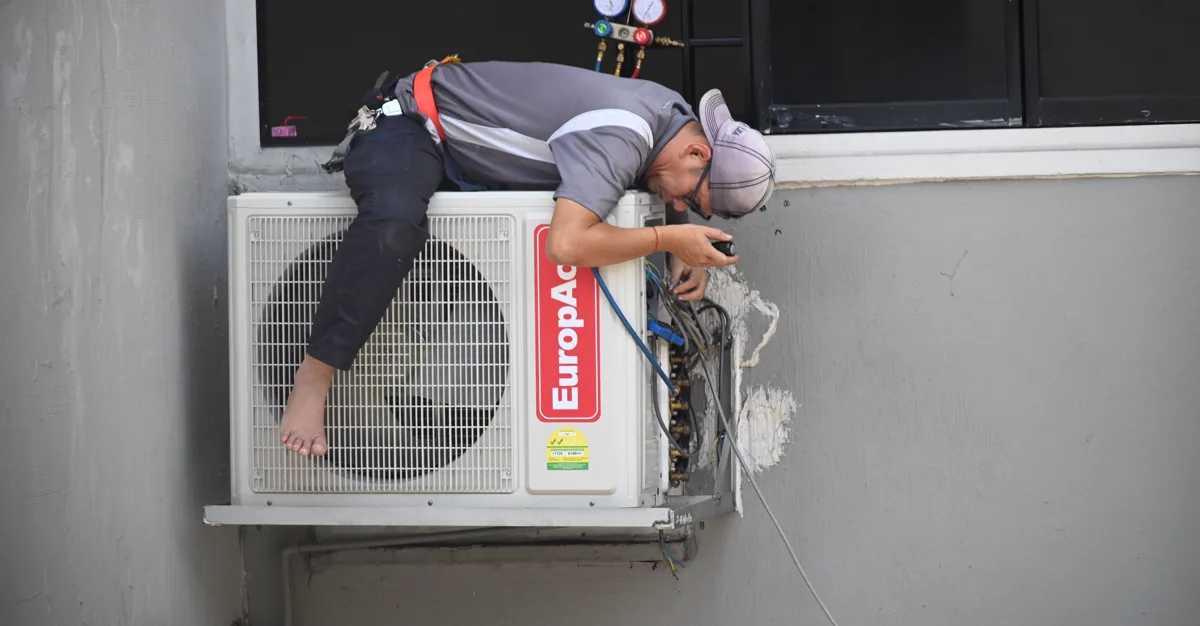
Every HVAC site we checked sells a membership. One tells you the price.
We opened four established HVAC company websites in July 2026 and checked each one for the same things. The result was more uniform than anything we found looking at plumbers or electricians.
All four sell a maintenance membership, and all four put it on the homepage. Morris-Jenkins calls theirs Priority Advantage. Parker and Sons runs the Parker Family Plan. Standard Heating has the Smart Club. Estes Services offers four tiers. Different names, same product: pay monthly, get your system looked at twice a year, jump the queue when it breaks.
Exactly one of the four publishes what it costs. Estes lists tiers running from $16.95 a month for the basic HVAC plan up to $36.95 for whole-home coverage. The other three describe the benefits and make you contact somebody to find out the number.
All four also mention financing, which is the other thing HVAC has that most trades do not. When the answer to a service call might be a system replacement running into five figures, financing stops being a nice extra and becomes the thing that decides whether the job happens at all.
| Site | Membership | Price shown | Financing | Reviews on homepage |
|---|---|---|---|---|
| Estes Services | 4 tiers | Yes, $16.95 to $36.95/mo | Named lenders | 4.9, 6,000+ |
| Standard Heating | Smart Club | No | On approved credit | 4.9, over 6,000 |
| Parker and Sons | Parker Family Plan | No | Multiple plans | 15,000+ Google |
| Morris-Jenkins | Priority Advantage | No | In the footer | Linked, not shown |
If you run a smaller HVAC company, that table is a short list of things your competitors have already decided are worth doing. The membership plan in particular is the closest thing the trade has to predictable income, and it is sitting on every one of these homepages for a reason.
Estes Services: the only one that publishes the number
Estes Services in Atlanta puts its plan pricing on the site. Four tiers, from $16.95 a month up to $36.95, each with priority scheduling and repair discounts attached.
Publishing the price does something the other three give up. It lets someone decide at eleven at night without talking to anybody. A homeowner who has just been quoted for a repair can work out on their own that a plan costs less per month than a coffee and covers the tune-ups they keep forgetting. Making them call to find that out adds a step, and steps are where people drop out.
The rest of the site is unusually complete. The headline names the trade and the city in one line, HVAC, plumbing and electrical experts in Atlanta, which is the correct way round for local search. Family-owned since 1949 sits directly underneath. Financing is named down to the lenders, Wells Fargo and Microf, rather than left as the word financing. Thirty-plus metro neighbourhoods are listed and searchable by zip.
The mechanism: put the plan price on the page. You are not going to win a bidding war on a maintenance plan, and the number is almost always smaller than people assume.
Parker and Sons: the surcharge that is not there
Parker and Sons in Phoenix leads with a line most companies would be too cautious to use: we are not your average Joe. Underneath it sits the part that matters, which is 24/7 service with no extra charge for nights, weekends or holidays.
That is the same move we found on a plumbing site, and it works for the same reason. Advertising round the clock availability raises an immediate question about what the after-hours rate is. Answering it in the same breath removes the hesitation rather than creating it. Most companies leave the customer to imagine the surcharge, and people imagine badly.
They also carry more than 15,000 Google reviews, an A plus BBB rating and a claim to have been voted number one by consumers fourteen years running. On a smaller site that stack would look like clutter. At their scale it reads as evidence, which is the thing to understand before copying a competitor's badge wall.
The mechanism: if you do not charge extra after hours, say so on the homepage. It is one clause and it answers the question your own offer just raised.
Morris-Jenkins: text to schedule
Morris-Jenkins in Charlotte is the only one of the four offering a text option next to the phone number. Call, or send a message and book that way.
This is worth more than it looks. Plenty of people will not phone a company they have never used, and a form that asks for a name, an email, a service type and a preferred window is its own kind of obstacle. A text is neither. It is also the channel a homeowner is already holding when the AC stops in July.
Their headline leans on speed and ease rather than credentials, and the membership is called Priority Advantage, which is a more honest name than most: what you are buying is position in the queue. When it is ninety-five degrees and everyone in the county has called the same six companies, position in the queue is the entire product.
The mechanism: add a second way to reach you that is not a form. Text is cheap to set up and catches the people who will not call.
Standard Heating: ninety-six years and six thousand reviews
Standard Heating in Minneapolis has been going since 1930 and puts the number where you cannot miss it, alongside over 6,000 reviews at a 4.9 Google rating.
Two numbers, both checkable, both doing different jobs. The year says the company will still exist when the warranty matters. The rating says the last few thousand people were happy. Longevity on its own can read as complacency, and a high rating on its own says nothing about whether you will be around in a decade. Together they cover each other.
Financing is handled plainly with a line about approved credit and a link to see options. That is the minimum viable version and it is enough. What matters is that a homeowner staring at a five figure replacement quote can see, without asking, that paying for it over time is possible.
The mechanism: pair a number about how long you have been here with a number about how you are doing lately. Either alone is weaker than both.
The site has two jobs, six months apart
HVAC is the only trade on this list where the same website has to sell two different things depending on the month, and none of the four handles it especially well.
In July, somebody arrives at your site sweating, on a phone, wanting to know how fast you can get there. In January the same page needs to talk about no heat. In the shoulder months, when nothing is broken, the visitor is a completely different person: they are shopping for a tune-up, comparing replacement quotes, or idly wondering whether their fifteen year old system will survive another winter.
Most HVAC sites are built for one of those three and left alone. The emergency version shouts about 24/7 availability all year, which is wasted on someone in April. The catalogue version lists equipment brands, which is useless to someone whose house is ninety degrees.
The fix is not a seasonal redesign, which nobody has time for. It is making sure the page carries all three paths at once, in the right order. Emergency contact at the top where the panicked visitor lands, planned work and the maintenance plan in the middle for the person browsing, and replacement with financing further down for the one doing research. A single page can serve all three if somebody has thought about it.
The tell that nobody has is a homepage that only makes sense in one season. If your site still leads with air conditioning in December, it was written once and never revisited.
Why financing belongs on an HVAC homepage
This is the part that separates HVAC from the other trades, and it is the thing smaller companies most often leave off.
A plumbing call usually ends in a repair. An HVAC call in the middle of a heatwave can end with somebody being told their system is finished and a replacement will cost more than their car did. That conversation goes one of two ways depending on whether the homeowner already knows financing exists.
All four of these companies mention it, and the better implementations name the lender rather than using the word financing as a link. Naming Wells Fargo, as Estes does, converts an abstraction into something a person recognises. It also quietly signals that the arrangement is real rather than an in-house payment plan with terms nobody wants to read.
You do not need a finance department to do this. Every major equipment manufacturer runs a consumer financing programme through a lender, and most HVAC contractors already have access to one through their distributor. The website work is a sentence and a link.
The three-line version. If you do nothing else to your HVAC site this month, add these. A line naming your maintenance plan and what it costs. A line saying whether nights and weekends cost extra. A line saying financing is available and who provides it. Those three answer the questions that decide most HVAC jobs, and none of them require a designer.
What to copy this week
Four sites, and a list any HVAC company can work through without hiring anyone.
- Put the maintenance plan on the homepage. All four do. It is the closest thing this trade has to recurring income.
- Publish what the plan costs. Only one of four does, which makes it the easiest place to be different.
- Say whether after-hours costs extra. Advertising 24/7 without answering this leaves people guessing.
- Name your financing lender. Not the word financing. The actual name.
- Offer a way in that is not a phone call or a form. Text, in most cases.
- Show two numbers, not one. Years in business and current review score.
- Put the city in the headline. Estes does it and it is free.
None of that is a redesign. It is roughly six sentences, a price and a link, which is usually where the gap is on trades websites. We ran the same exercise on a different trade in our breakdown of plumbing website examples, and on electrician website examples, where the standout finding was that only one company of six displayed its license number.
Two things worth keeping in mind underneath all of it. Google indexes the mobile version of your site, not the desktop one, which its mobile-first indexing documentation states directly, and an HVAC emergency is about as mobile as searches get. And if you advertise financing terms, the FTC's advertising and marketing guidance is worth a read, because credit terms are one of the areas where what you say has to match what you actually offer.
If you want the full picture of what belongs on an HVAC contractor's site rather than what these four happen to do, we keep that on our HVAC website design page, and our pricing page covers what a build costs.